
FMNR, Key Transformation Indicators (KTIs) and
the Road from UNCCD COP17 to UNFCCC COP31
Nov 15, 2026 · Luc Gnacadja, Mayor of Cotonou – Former Executive Secretary of the UNCCD
Nearly thirty years after external funding ended, farmers in Niger’s Tahoua region are still restoring degraded land, and Farmer Managed Natural Regeneration (FMNR) has spread across some six million hectares, driven by farmers themselves. Prompted by an exchange with Chris Reij following my COP17 Perspective, this article reads that evidence through the lens of Key Transformation Indicators (KTIs). Its lesson reaches beyond the Sahel: as COP31 debates how to measure and finance adaptation, the real test of land restoration and climate resilience is not what a project delivers, but what people keep doing, and improving, long after it has gone.
A question sent from Cotonou, an answer from the Sahel
In August, following UNCCD COP17 in Ulaanbaatar from Cotonou, I published a short Perspective, Beyond LDN Targets: Why Land Restoration Needs Key Transformation Indicators (KTIs). Its central question was simple: beyond what we have pledged and delivered, are we building the capacity of societies, institutions and landscapes to keep transforming once project funding cycles or political mandates end?
Among the responses, one stood out. Chris Reij, who has spent more than four decades documenting farmer-led regreening in the Sahel, wrote to me from Tanzania on the eve of a field visit to villages practising Farmer Managed Natural Regeneration (FMNR). His answer was not a theory. It was two stories from Niger, a country long ranked among the poorest in the world, where farmers have sustained landscape transformation for decades.
Those stories test the KTI idea better than any framework could. And they arrive at a timely moment: as I write, COP31 is under way in Antalya, with adaptation, and how to measure and finance it, at the heart of the negotiations.
What happened after the project ended
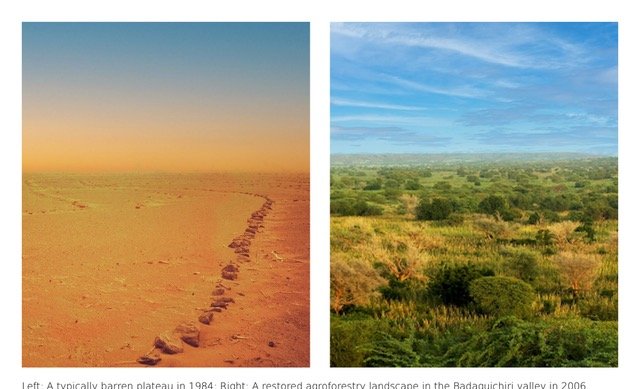
Tahoua: thirty years on. From 1988 to 1995, an IFAD-funded project in Illéla District, in Niger’s Tahoua region, helped farmers restore degraded plateaus with two simple techniques: zaï planting pits and half-moon catchments. The idea came from a study visit by 13 farmers to Yacouba Sawadogo, the Burkinabè innovator who had improved the traditional zaï. Instead of food for work, villages that restored land earned support for a classroom, a clinic or a well.
The project restored some 5,765 hectares of severely degraded cropland and 585 hectares of silvopastoral land. Yields on restored plots were about four times those of untreated land. Those are the numbers a final report would record. What followed is more telling:
- Farmers outside the project area, who saw the results with their own eyes, adopted the techniques on their own.
- A market for degraded land emerged: by 1998, 40% of household heads interviewed had bought degraded land in order to restore it.
- In a drought year, families with restored land met 72% of their cereal needs, against 42% for those without.
- Manure in the pits carried tree seeds; farmers protected the seedlings, and barren plateaus became agroforestry parklands.
- In Batodi, villagers estimated that well water rose by around 14 metres by 2004. Vegetable gardens grew from four to eleven by 2019, and pastoralists now keep their herds near the village all year.
- After the project, farmers adapted the techniques themselves, tightening the spacing of half-moons and shifting to the simpler planting pits.
Field visits between 2004 and 2019 found farmers still maintaining and extending these practices, nearly three decades after external funding stopped. In the neighbouring districts, projects that had relied on bulldozers and graders left works that neither communities nor government maintained.
FMNR: six million hectares. The second story is larger still. According to Chris, FMNR now covers about six million hectares of farmland in Niger. Projects played a role, but the practice spread mainly because farmers saw its effects on their neighbours’ fields. Village institutions emerged to protect and manage the tree capital. Practice came first and policy followed: a presidential decree in July 2020 confirmed farmers’ rights to the trees on their land.
Reading Niger through the KTI lens
Consider what a conventional assessment would have shown in 1995. The IFAD project and its mechanised neighbours could both report hectares treated, works built and people mobilised. Their KPIs might have looked comparable. Only one of them transformed a landscape. That gap, between what a project delivers and what a system becomes able to do, is exactly what KTIs are meant to make visible.
The four KTI questions read the Niger evidence as follows:
| KTI question | What the Niger evidence shows |
| 1. Are interventions creating transformational potential? | A farmer-to-farmer study visit, simple and cheap techniques, and incentives that built community assets rather than paying for labour |
| 2. Are local actors becoming agents of transformation? | Farmers outside the project adopted the techniques unprompted, adapted them, specialised as hired diggers and revived traditional work parties |
| 3. Is change becoming self-reinforcing? | Higher yields, a land market for degraded plots, rising water tables, gardens and fodder created benefits that financed their own continuation |
| 4. Can the transformation endure and adapt? | Practices maintained for three decades after funding ended, adapted by farmers, and sustained through Niger’s deep political and economic crisis of the 1990s |
Three lessons stand out.
Transformation does not always need permanent support or even formal institutions. In Tahoua, no village institution was built around zaï, yet the practice endured. What mattered was that the system acquired the capabilities, incentives, relationships and agency to reproduce change on its own. In the case of FMNR, by contrast, village institutions and locally enforced bylaws were part of what made it last. KTIs must therefore look for the conditions of autonomy, not for a single model of it.
Benefits are the trigger. As Chris puts it, the farmers practising FMNR are benefit-driven: they do not protect trees for the beauty of the landscape, but because trees produce fodder, firewood, fertility and income. A KTI assessment should ask early whether the change pays for those who must sustain it.
Transformation can advance when the signals look negative. Niger’s farmers kept investing in trees during a period of severe national crisis. Conventional indicators of context would have predicted failure. This is why KTIs assess the system’s own capacities rather than inferring them from the surrounding conditions.
These observations are consistent with the research literature. Analysing the regreening of Niger’s Maradi and Zinder regions, Sendzimir, Reij and Magnuszewski (2011) found that forest decline was reversed when interventions helped shift reinforcing feedbacks from vicious to virtuous cycles, and that reversals were preceded by changes in governance, then in livelihoods, and only later in the biophysical environment. The earliest signals of transformation, in other words, appear in institutions and behaviour long before they show up in land-condition data. That is precisely where KTIs look.
The diffusion literature explains the spread: innovations that offer a clear advantage, are simple to use and produce visible results are adopted fastest (Rogers, 2003). And evaluation research defines sustainability as outcomes that are maintained or expanded after a project withdraws (Rogers and Coates, 2015), yet such studies rarely look more than two or three years beyond exit. Tahoua offers a thirty-year view.
From land to climate: what Antalya should hear
Seen through the lens of the UN Convention to Combat Desertification, Tahoua and FMNR are textbook cases of reversing land degradation, the third step of the LDN response hierarchy of avoiding, reducing and reversing degradation. LDN’s indicators of land cover, land productivity and soil organic carbon would record their gains. What they cannot tell us is why those gains endured, or whether similar investments elsewhere will. That is the question KTIs add. The same experience speaks to the drought agenda that weighed so heavily on COP17: restored land protected harvests in drought years, which is anticipatory resilience in practice.
The Tahoua farmers did not set out to adapt to climate change, yet that is what they achieved. Restored land held rainfall, recharged groundwater, protected harvests in drought years and kept herds at home through the dry season. The trees that returned to the plateaus also store carbon. This is the synergy the Paris Agreement anticipates when its Article 4.7 recognises that the mitigation co-benefits of adaptation can contribute to mitigation outcomes.
At COP31 in Antalya, adaptation is one of the hardest questions on the table.
Under the Global Goal on Adaptation, Parties adopted the UAE Framework for Global Climate Resilience in 2023. Its targets include climate-resilient food and agricultural production, sustainable and regenerative production, and ecosystem-based adaptation and nature-based solutions. At COP30 they adopted 59 Belém Adaptation Indicators to track progress. In Antalya, Parties are discussing how to use those indicators and how to deliver the call to triple adaptation finance; an African proposal to give that tripling its own agenda item did not succeed. The need is not in doubt: developing countries are estimated to require around US$305 billion a year for adaptation.
Niger’s experience offers a lesson for that debate. One of the Belém indicators measures the proportion of agricultural area managed with practices relevant to adaptation. Tahoua would have scored well in 1995, but so might a project whose works were abandoned a few years later. Indicators of this kind tell us whether adaptation is under way. They do not tell us whether the capacity to adapt has become self-sustaining. Yet enhancing adaptive capacity is the Paris Agreement’s own adaptation goal, and its Article 7.5 asks that adaptation be participatory and guided by traditional and local knowledge, exactly what Tahoua’s farmers demonstrated. Whether that capacity endures determines whether each dollar of adaptation finance is spent once, or keeps returning value for decades.
Adaptation indicators and KTIs are complementary. The first measure progress towards resilience; the second ask whether resilience is becoming the system’s own. Negotiators in Antalya are rightly calling for locally led adaptation. The Sahel shows what that looks like when it works, and why its success must be judged years after the funding ends.
What this asks of funders and policymakers
Chris put his finger on the core difficulty. Donors favour four-year projects that define in advance what must be achieved, and they report success when the targets are met. When funding stops, the best one hopes for is that the gains will be maintained. Projects designed to catalyse self-sustaining processes are different: we know where we start, but not where we will be in ten or twenty years. That uncertainty is hard to accept for institutions built around fixed targets. It is also where transformation lives.
Four shifts would help:
- Fund the conditions, not only the outputs. Farmer-to-farmer exchanges, communication that lets people see results with their own eyes, and the village institutions and bylaws that protect shared assets are what made Niger’s gains spread.
- Secure rights before scaling. Outdated forestry laws that require farmers to buy a permit to cut a tree they have nurtured treat them as adversaries rather than allies. Niger’s 2020 decree shows the alternative: recognise farmers’ rights to their trees.
- Back what already works. Organisations with a proven record often struggle to find funding while they are ready to expand. Chris is now working to create a dedicated fund for FMNR for exactly this reason.
- Measure transformation years after the project. Post-project assessments, like the one Chris and Abdou Hassane carried out in Tahoua, should become standard practice, alongside a transformation baseline set at the start. LDN and adaptation indicators would then sit beside KTIs, not in place of them.
The farmers were there before the indicators
Chris ended one of his messages with a remark that has stayed with me: many experts do not always see what farmers are doing themselves. In Malawi, he notes, smallholders have built on old traditions to regenerate trees at a scale that has largely escaped the attention of foresters, policymakers and consultants. He also wondered whether the same inventive energy is at work in the informal economy of cities like Cotonou. I believe it is, and it is equally invisible to most of our indicators.
That is perhaps the deepest purpose of KTIs: to train our attention on the capacities that people and places are already building, so that we can recognise, protect and accelerate them. From Ulaanbaatar to Antalya, the conventions have set the targets. The farmers of Tahoua remind us of the real test.
Transformation is not what a project leaves behind. It is what people keep doing, and keep improving, long after it has gone.
My thanks to Chris Reij for an exchange that deserves a wider audience.
Luc GNACADJA
Mayor of Cotonou
Former Executive Secretary of the UNCCD
President of GPS-Development
Sources
- Gnacadja, L. (2026). Beyond LDN Targets: Why Land Restoration Needs Key Transformation Indicators (KTIs). COP17 Perspective, GPS-Development, 27 August 2026.
- Hassane, A. and Reij, C. Post-project impacts of restoring degraded land in Tahoua, Niger. ETFRN News 60.
- Reij, C. Personal communication with the author, November 2026.
- Sendzimir, J., Reij, C. P. and Magnuszewski, P. (2011). Rebuilding resilience in the Sahel: regreening in the Maradi and Zinder regions of Niger. Ecology and Society 16(3): 1.
- Rogers, E. M. (2003). Diffusion of Innovations, 5th edition. Free Press.
- Rogers, B. L. and Coates, J. (2015). Sustaining Development: A Synthesis of Results from a Four-Country Study of Sustainability and Exit Strategies among Development Food Assistance Projects. FHI 360/FANTA.
- Paris Agreement (2015), Articles 4.7, 7.1 and 7.5.
- UNFCCC. Global goal on adaptation: UAE Framework for Global Climate Resilience and Belém Adaptation Indicators.
- IISD Earth Negotiations Bulletin. Daily report for 13 November 2026, COP31.
- The Star (Kenya). Setback for Africa as COP31 rejects push to triple adaptation finance, 14 November 2026.